Home › Long-term rental
Rent or Buy on Koh Samui in 2026?

Every long-term resident on Koh Samui eventually asks the same question: keep renting, or buy? The answer depends less on the island and more on the legal rules for foreign buyers in Thailand, the real costs of a purchase, and how long you plan to stay. This guide sets out what foreigners can legally own on Samui, what a purchase costs, and how to think about the rent-versus-buy trade-off, using 2026 information.
This article is general information, not legal or financial advice — for a decision on your own situation, confirm the current rules with a Thailand-qualified, independent lawyer before signing anything.
What can foreigners actually own on Koh Samui?
Thai law treats condominiums and land very differently, and the difference is the starting point for any rent-or-buy decision.
Condominiums: freehold ownership, up to the 49% foreign quota
Foreigners can buy a condominium unit outright, in their own name, as full freehold property — the most legally straightforward way for a non-Thai to own real estate in Thailand. The catch is the foreign ownership quota in the Condominium Act: foreigners as a group may own no more than 49% of the total saleable floor area of a given building, not simply 49% of the number of units. In a popular, already well-sold building, the quota can be full even if individual units are still listed — ask the juristic person (the building's management office) to confirm the current foreign-ownership percentage before you commit to a unit.

Land: no direct ownership, leasehold up to 30 years
Foreigners cannot directly own land in Thailand. For a house or villa on its own plot, the standard route is a registered lease of the land for up to 30 years at the local Land Office, combined with ownership of the building itself (typically registered in the foreigner's name separately from the land). A narrow exception exists in the Land Code for very large, qualifying investments, but it is not a realistic route for an individual buying a home.
Thai company structures: a legal risk, not a workaround
Some buyers are offered a Thai limited company as a way to hold land indirectly, with the foreigner as a minority shareholder or director. This is a genuine legal risk, not a grey area: setting up a company with nominee Thai shareholders purely to let a foreigner control land goes against the intent of the law, and enforcement has visibly tightened. In 2026, the Department of Special Investigation (DSI) and the Department of Business Development (DBD) publicly named Koh Samui and Koh Phangan as focus areas for an intensified crackdown on nominee shareholding structures. We are not citing specific numbers of investigations or forced sales here, since we could not verify reliable figures — but the direction of enforcement is clear enough that a company structure should be treated as real legal, and in serious cases criminal, exposure, not a paperwork formality. If one is ever proposed to you, get independent advice from a licensed Thai lawyer who does not work for the seller or developer before proceeding.
What does buying actually cost?
Beyond the purchase price itself, a handful of government fees and taxes apply at the Land Office when a property changes hands. The exact mix depends on how long the seller has owned the property and how the deal is structured, but the components are consistent:
- Transfer fee: around 2% of the appraised or sale value, normally split between buyer and seller by negotiation (there is no legal requirement on who pays what share — it is a contract point).
- Specific Business Tax (SBT): 3.3% of the sale or appraised value, which applies if the seller has held the property for less than 5 years.
- Stamp duty: 0.5% instead of SBT, if the seller has held the property for 5 years or more (the two are alternatives, not both charged together).
- Withholding tax, calculated by the Revenue Department from the sale price, appraised value and the seller's holding period. It varies case by case, so confirm the exact figure with the Land Office or a lawyer before completion rather than assuming a fixed percentage.
On top of these government charges, budget for a lawyer to review the sale and purchase agreement and, for a leasehold villa, the lease contract — this is a cost worth paying rather than skipping.
The temporary 0.01% fee reduction does not apply to foreign buyers
Thailand has run temporary measures that cut the transfer fee (and, for financed purchases, the mortgage registration fee) to as low as 0.01% on lower-priced properties, as economic stimulus. It is worth being explicit about this: these reduced-fee measures have applied to Thai national buyers, not to foreign buyers of condominium units. As a foreign buyer, plan around the standard ~2% transfer fee rather than assuming a stimulus rate will apply to you — check the current Land Office notice for your specific transaction if you are unsure.
How liquid is the resale market on Samui?
It is more honest here to say plainly what is not known than to guess: there is no reliable, official data on how long condos or villas typically sit on the market when resold on Koh Samui, what price discounts resales achieve, or how many resale (as opposed to new-build) transactions happen each year. Market reports for Samui mostly describe the primary market — new developments sold by developers — rather than the owner-to-owner resale market. The widely repeated view is that Samui's resale market is smaller and less liquid than Phuket's or Bangkok's, given the smaller buyer pool and limited buildable land. Treat that as a reasonable expectation, not a documented fact — if resale speed matters to your decision, ask local agents for recent comparable sales rather than general market commentary.
Renting vs buying a condo vs leasehold villa
| Renting | Buying a condo (freehold) | Buying a villa (leasehold land) | |
|---|---|---|---|
| Flexibility | High — leave at the end of a lease term or by agreement | Low — selling takes time in a thin market | Lowest — land lease terms and building ownership both need unwinding |
| Upfront cost | Deposit plus 1–3 months' rent in advance | Full purchase price plus ~2–4% in fees/taxes plus legal costs | Purchase/lease price plus fees, taxes and legal costs on both the lease and the building |
| Legal security | Governed by your rental contract and, for larger landlords, consumer-protection rules | Strong — freehold title in your own name, within the 49% quota | Weaker — a time-limited lease right, not ownership of the land itself |
| Exit | Simple — give notice per the contract | Depends on finding a buyer; no reliable resale-speed data for Samui | Depends on finding a buyer for the remaining lease term and building; typically the hardest of the three to exit |
For what typical rents actually look like across areas and property types on Samui right now, see our separate guide to long-term rental prices on Koh Samui rather than relying on numbers repeated elsewhere — and if you decide renting is the right call for now, our guide on how to find a long-term rental on Koh Samui covers the practical steps.
When does buying start to make sense?
There is no official, government-published break-even point between renting and buying on Koh Samui — anyone giving you a precise number is presenting a personal estimate as fact. Independent estimates for condos have ranged roughly 7 to 15 years of ownership before buying overtakes renting on a like-for-like basis, and that range itself is a rough heuristic, not a formula to trust blindly. It moves considerably depending on how you plan to use the property and the purchase price relative to achievable rent.
The logic behind the heuristic is straightforward, even if the exact number isn't:
- Transaction costs cut both ways. The ~2–4% you pay in fees and tax when buying is effectively lost the moment you sell again, so a short holding period rarely recovers it.
- Ongoing ownership costs add up. Common-area (CAM) fees, sinking fund contributions, maintenance, and — for a villa — land lease payments and upkeep, are costs a renter simply doesn't carry.
- Opportunity cost matters. Money tied up in a deposit and purchase price could otherwise be invested elsewhere; the "return" from owning has to beat that alternative, not just beat rent.
- Renting keeps you flexible. If your stay on Samui, your visa situation, your job, or your family circumstances could change within a few years, that flexibility has real value that a break-even calculation in isolation doesn't capture.
As a rough starting point: if you are confident you will hold the property for well over a decade, and you have priced in ownership costs rather than just the purchase price, buying a condo is worth modelling seriously. If your horizon is shorter or uncertain, renting keeps your options open at a lower, more predictable monthly cost — and sidesteps the resale-liquidity question above entirely.
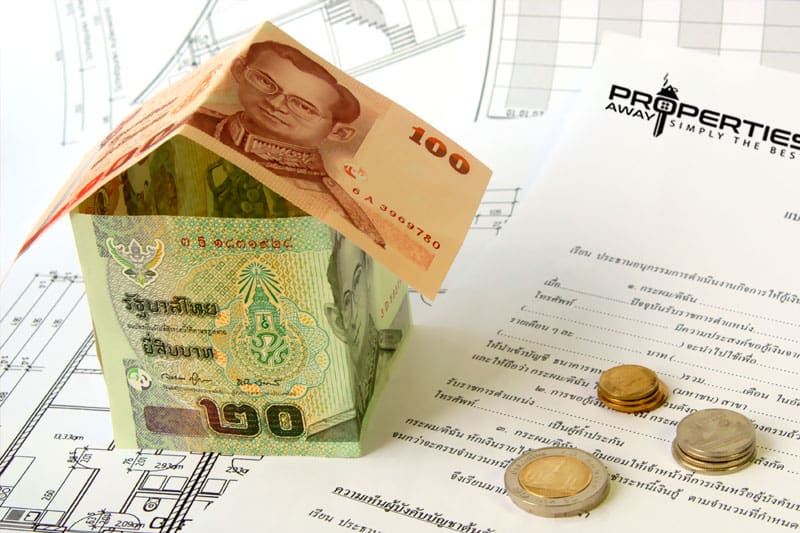
Checklist: before you sign a purchase
- Confirm the building's current foreign-ownership percentage with the juristic person — not just the developer's sales team — before reserving a unit under the 49% quota.
- For a leasehold villa, check the registered lease term at the Land Office directly, not just what the sale brochure states.
- Get an independent, licensed Thai lawyer — one you pay directly, not one recommended and paid for by the seller or developer — to review the sale and purchase agreement and any lease contract.
- Ask the seller directly how long they have owned the property, since that determines whether Specific Business Tax (3.3%) or stamp duty (0.5%) applies, and get the fee split agreed in writing.
- Do not enter a Thai company or nominee shareholder structure to hold land without independent legal advice — treat any such proposal as a legal red flag, not a routine option.
- Ask for recent, comparable resale sale prices and time-on-market from more than one local agent, since no official resale statistics exist for Samui.
- Factor in ongoing costs — CAM/sinking fund fees for a condo, or land lease and maintenance for a villa — not just the purchase price, before comparing against renting.
Frequently asked questions
Can foreigners buy property in Koh Samui?
Foreigners can buy a condominium unit as full freehold property, as long as foreign ownership of the building stays within the 49% foreign quota (measured by total saleable floor area, not unit count). Foreigners cannot directly own land — houses and villas are typically held via a registered land lease of up to 30 years plus separate ownership of the building.
Can a foreigner buy a condo in Koh Samui, and how does the 49% quota work?
Yes, within the building’s foreign quota. The Condominium Act caps foreign ownership at 49% of a building’s total saleable floor area. In a well-sold building the quota can already be full even if units are still listed for sale, so it is worth confirming the current percentage with the building’s juristic person before reserving a unit.
Is it safe to buy land through a Thai company?
Using a Thai company with nominee shareholders to let a foreigner control land is a genuine legal risk, not a routine workaround. Enforcement has tightened in 2026, with Koh Samui and Koh Phangan specifically named as crackdown focus areas by the DSI and DBD. Anyone considering this should get independent advice from a licensed Thai lawyer first.
What does it cost to buy property in Koh Samui?
Typical government charges are a transfer fee of around 2%, plus either Specific Business Tax (3.3%) if the seller has owned the property under 5 years, or stamp duty (0.5%) if held 5 years or more, plus withholding tax calculated case by case. A temporary reduction of these fees to 0.01% has applied to Thai national buyers only, not to foreign buyers.
After how many years does buying beat renting on Koh Samui?
There is no official figure. Independent estimates for condos have ranged roughly 7 to 15 years before ownership overtakes renting on a like-for-like basis, and this is a rough heuristic that depends heavily on how you use the property, the purchase price, and ongoing costs like CAM fees — not a number to apply directly to your own situation.
Sources
Last checked: 19 September 2026. Facts were cross-checked against several sources; official ones take priority.
- Ownership of real estate by foreigners in Thailand: Requesting ownership of a condominium unit (2026-09-16)
- Foreign property ownership in Thailand: Fees for condominiums (2023-01-16)
- Can foreigners buy real estate in Thailand? (2021-11-16)
- DSI and DBD Intensify Crackdown on "Nominee" across Tourist Destinations in Koh Samui - Koh Phangan (2026-05-11)
- Thailand tightens crackdown on nominee firms (2026-07-01)
- Stamp Duty Schedule (2008-06-09)
- Department of Lands FAQ (2025-09-11)
- Koh Samui Residential Report 2025 (Colliers)
- Internal fact-check: rent-or-buy question, 2026-09-19-mietratgeber-welle2.md (2026-09-19)
More from the Long-term rental

Cost of Living on Koh Samui 2026: Monthly Budget Guide
What life on Koh Samui really costs in 2026 without rent: food, scooter, fuel, phone and gym prices, plus two worked example monthly budgets.

Digital Nomads on Koh Samui 2026: DTV Visa & Alternatives
DTV visa rules for 2026, LTR, Privilege and retirement visa alternatives, plus internet, coworking and TM30/90-day/tax duties for nomads on Koh Samui.
How to Find a Long-Term Rental on Koh Samui
How to find a long-term rental on Koh Samui: agents, Facebook groups and portals, who pays the agent's commission, and how to avoid common rental scams.